

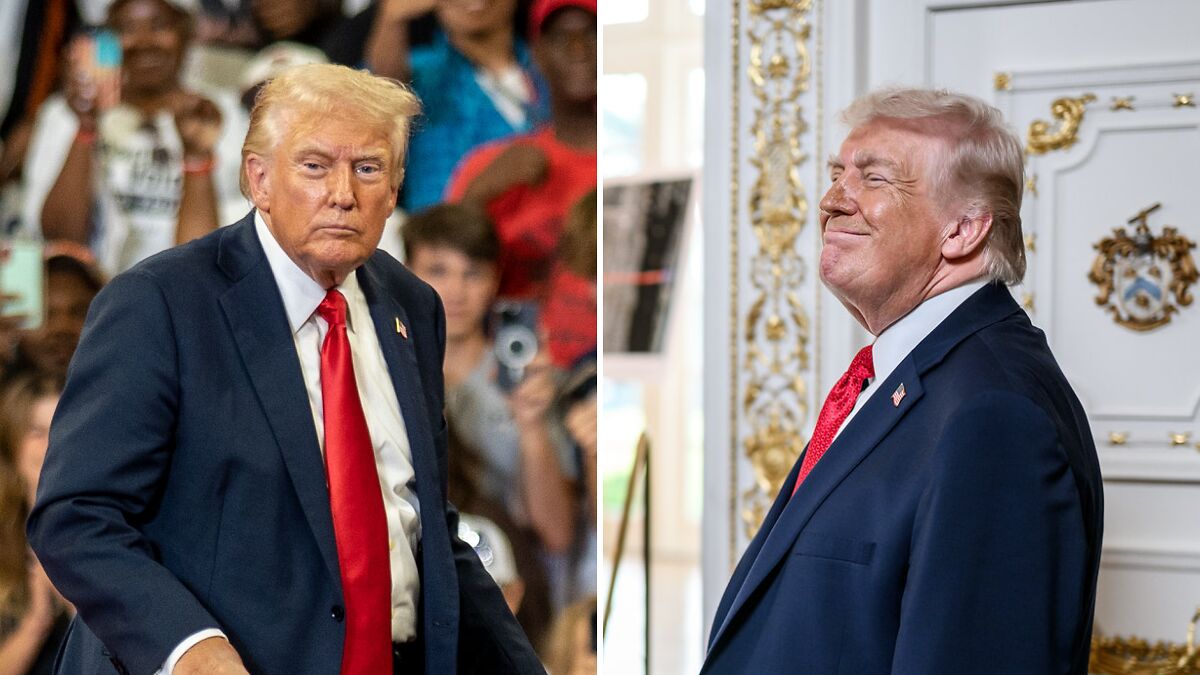
There are two kinds of political theatre. The first is deliberate: carefully staged, rehearsed, and tested on focus groups. The second is more impromptu.
The recent report of U.S. President Donald Trump stopping mid-sentence during an interview, tapping his own head, and asking the room for help remembering the name of a disease—in the midst of insisting others are unfit—means we are firmly in the second category.
- In a recent interview, President Trump paused, tapped his head, and struggled to recall the word 'Alzheimer’s'.
- Trump often accuses Biden of cognitive decline despite his own visible public memory lapses and speech errors.
- The president claims to have 'aced' a cognitive test, but details and verification of the result remain elusive.
- Medical experts warn that Trump's public behavior shows signs of cognitive decline.
The latest viral Trump ‘moment’ has reignited questions he throws at rivals
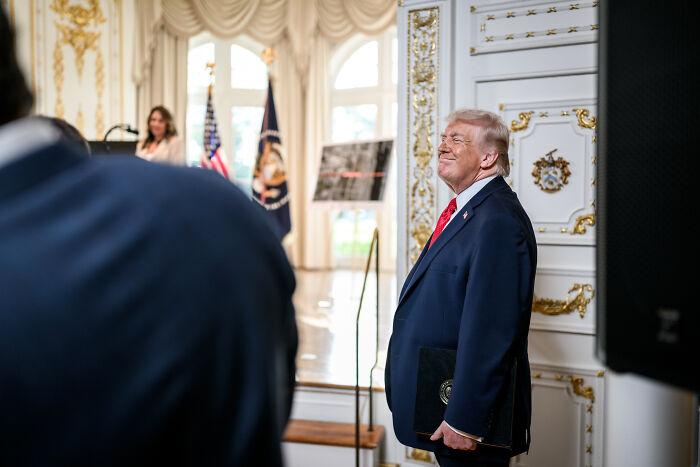
Image credits: The White House/Flickr
Trump, 79, has made “mental fitness” a recurring insult aimed at his opponents, particularly former President Joe Biden. He has commented on his alleged mental decline loudly, repeatedly, and with the confidence of a man who understands that—in politics at least—repetition is often the same thing as evidence.
Unfortunately for Trump (and for those tasked with damage control), the last year has also produced a steady anthology of moments that suggest the universe has a sense of humor—and is not on the administration’s payroll.
This is not a diagnosis. It is not a joke about mental illness. Mental decline is common among people in Trump’s age group, and it’s a serious thing. This, however, is a list of things that actually happened—in public—followed by reactions, walk-backs, and a growing sense that reality is blinking first.
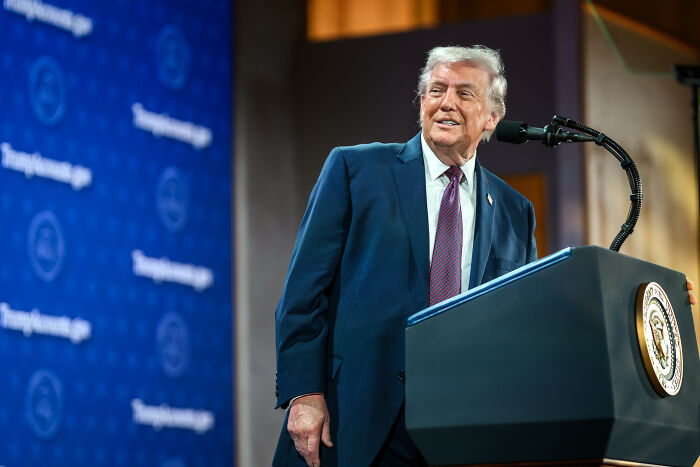
Image credits: The White House/Flickr
‘What do they call it?’ (aka: The Alzheimer’s moment)
The latest Trump moment to blow up social media came while he was discussing his father’s illness during a recently published interview with New York Magazine.
Trump reportedly paused and gestured at his head.
“What do they call it?” he asked.
White House Press Secretary Karoline Leavitt filled in the blank.
“Alzheimer’s,” she said.
The moment is extraordinary, not because memory lapses never happen, but because of the surrounding context: a president who routinely mocks others’ cognitive health, suddenly stranded mid-sentence, waiting for assistance like an obsolete computer encountering a thought too large to process.
Leavitt often has the unenviable job of standing between Trump and the consequences of his own mouth and has become something of an interpreter; translating statements that land like dropped plates into something resembling intentional communication.
It is a demanding role, requiring stamina, creativity, and the ability to maintain a straight face while explaining that forgetting a word you’ve just referenced is actually a sign of strength.
But there’s still no getting out of mispronouncing “acetaminophen” when you’re doing an entire press conference based on the dubious claim that it causes autism.
Trump struggled to pronounce a drug he said causes autism
Tariff checks and lies
One of the big tells was Trump forgetting that he promised to send Americans $2,000 in tariff checks. He asked, “When did I do that?” after saying—true pivot-fashion—that he did so for the military.
Before executing a familiar rhetorical somersault and insisting he meant it for the military, this wasn’t a policy clarification so much as a live-action memory hole: the kind where reality is gently escorted out of the room and replaced with a louder, more convenient version of events.
But the tariff check promise existed on record—on video and in print—yet Trump appeared genuinely unable to anchor himself to his own past statements. Whether framed as dishonesty or cognitive lapse, the result is the same: a president who weaponized accusations of mental unfitness against his predecessor now struggles to remember the promises he made to millions of people, and responds not with correction but with improvisation.
And improvisation, as any magician will tell you, only works if the audience believes you meant it all along.
“I aced it”: The cognitive-test victory lap
Trump has repeatedly claimed to have “aced” a cognitive test. Yet widespread reporting suggests it was not an IQ test, but rather a Montreal Cognitive Assessment (MoCA)—which is used to screen for cognitive impairment and neurological conditions such as Alzheimer’s.
That has not prevented Trump from using it to compare himself favorably to his critics.
“[The Democrats] have Jasmine Crockett, a low-IQ person. AOC [Alexandria Ocasio-Cortez] is low IQ. Have her pass, like, the exams that I decided to take when I was at Walter Reed. Those are really hard—really aptitude tests, I guess, in a certain way. But they’re cognitive tests,” Trump said in October.
But details of the test have remained elusive. No scores have been published. No independent verification has been undertaken.
— Mel Mills™ (@theMelMills) January 26, 2026
Countries, leaders, and the “You know the one” school of geography
There have been multiple instances in which Trump has mixed up countries, leaders, or concepts mid-speech, including repeatedly referring to Greenland as Iceland during a recent speech at the World Economic Forum.
Leavitt was on hand for damage control, writing on X that he “didn’t [confuse the two countries],” and that his “written remarks referred to Greenland as a ‘piece of ice’ because that’s what it is.”
Unfortunately for Leavitt, Secretary of State Marco Rubio told lawmakers on the Senate Foreign Relations Committee that, in fact, “he meant to say Greenland.”
Trump has also struggled to pronounce Azerbaijan, as well as confusing its neighbor Armenia with Albania on repeated occasions.
Speaking on Fox News, Trump said, “I solved wars that was unsolvable. Azerbaijan and Albania, it was going on for many, many years. I had the prime ministers and presidents in my office.”
“Hundreds of percents,” because that math definitely maths
Trump has regularly spouted questionable numbers, including suggesting that bringing prices down by “hundreds of percent” is possible.
During a dinner event at the American Cornerstone Institute, Trump failed to understand how percentages work, claiming that he would reduce drug prices by 1300%, apparently not grasping that the price of something cannot be reduced by more than 100%.
“Now I’m getting them down 500, 600, 800%,” he said. “In some cases, even more than that. It’s hard to believe.”
A 100% price drop would make an item free. Going past that—into the “500, 600, 800%” range Trump mentioned—would, in theory, mean paying people to take the medication.
Covfefe never died; it just learned to vote
Before there was the Alzheimer’s pause, there was one of the most infamous examples of Trump’s early morning social media posts, which simply said “covfefe.”
The infamous May 2017 tweet remains the Rosetta Stone of Trump communication: a typo, a mystery, a refusal to explain, and a loyal base insisting it meant something profound.
Years later, covfefe has become less an anomaly and more a preview. It established a pattern: say the thing, deny the mistake, let supporters invent meaning, move on.
The only difference now is that the stakes are higher—and the words are less cooperative.
Biden’s mental fitness (still somehow the main topic)
Despite all of the above, Trump continues to bring up Joe Biden’s mental fitness at rallies and interviews, often with the air of someone pointing out a flaw in another while standing in front of a mirror that is actively on fire.
This has not gone unnoticed.
President Trump continues to question his predecessor’s mental fitness
Many clips now circulate as split-screen comparisons: Trump accusing Biden of confusion, followed immediately by Trump losing his own train of thought. It is not editing trickery. It is chronology.
Enter Mary Trump, stage left
Mary Trump, Donald Trump’s niece and a psychologist, has repeatedly spoken about what she sees as long-standing emotional and psychological issues within the Trump family.
Her commentary is often careful, contextual, and grounded in family history. It is also deeply inconvenient for an administration that prefers the narrative of effortless competence.
She has said she believes he has dementia.
While that doesn’t represent a professional diagnosis, her training and close contact with him suggests she might have more insight than most.
What have doctors said?
Medical professionals are understandably cautious when it comes to speaking in absolute terms and many have stressed that they cannot diagnose someone they have not examined.
But some have noted that repeated, escalating lapses do suggest there is cause for concern.
Dr. Vin Gupta, a board-certified physician and frequent television medical analyst, has highlighted age-related cognitive concerns based on observed word-finding difficulties and public confusion.
Dr. John Gartner, a clinical psychologist and founder of Duty to Warn, has pointed to patterns of language deterioration and impaired executive functioning compared to Trump’s earlier baseline.
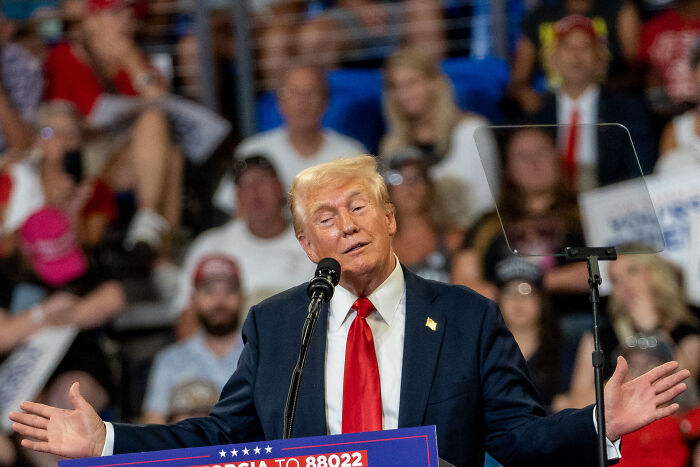
Image credits: The White House/Flickr
Psychiatrist Dr. Bandy X. Lee, co-author of The Dangerous Case of Donald Trump, has warned that while ethics prohibit formal diagnosis without personal examination, behavioral patterns visible in public settings can still be meaningfully interpreted as warning signs.
These voices underscore how behavioral patterns can offer serious weight—if not definitive conclusions—to doubts about the mental condition of a person.
Which makes Trump’s ongoing use of mental health as a weapon against Biden and others particularly problematic.
Not least because it’s a weapon that seems primed to catastrophically backfire at any moment.
Poll Question
Thanks! Check out the results:
Subscribe to Access
Exclusive Polls

By entering your email and clicking Subscribe, you're agreeing to let us send you customized marketing messages about us and our advertising partners. You are also agreeing to our Privacy Policy.
Thank you! You've successfully subscribed to newsletters!
1k+views
Share on Facebook


Not a US citizen, but I find some of dementia Don's more confused comments hilarious while also being appalled that the mango megalomaniac is President of the USA and in command of the nuclear codes.

Unfortunately for all you liberals you lost your right to make fun of a president's cognitive function after completely ignoring Biden's inability to form a coherent sentence, frequent falls, and naps while on duty. Nice try though.


Not a US citizen, but I find some of dementia Don's more confused comments hilarious while also being appalled that the mango megalomaniac is President of the USA and in command of the nuclear codes.
Unfortunately for all you liberals you lost your right to make fun of a president's cognitive function after completely ignoring Biden's inability to form a coherent sentence, frequent falls, and naps while on duty. Nice try though.

19
6